

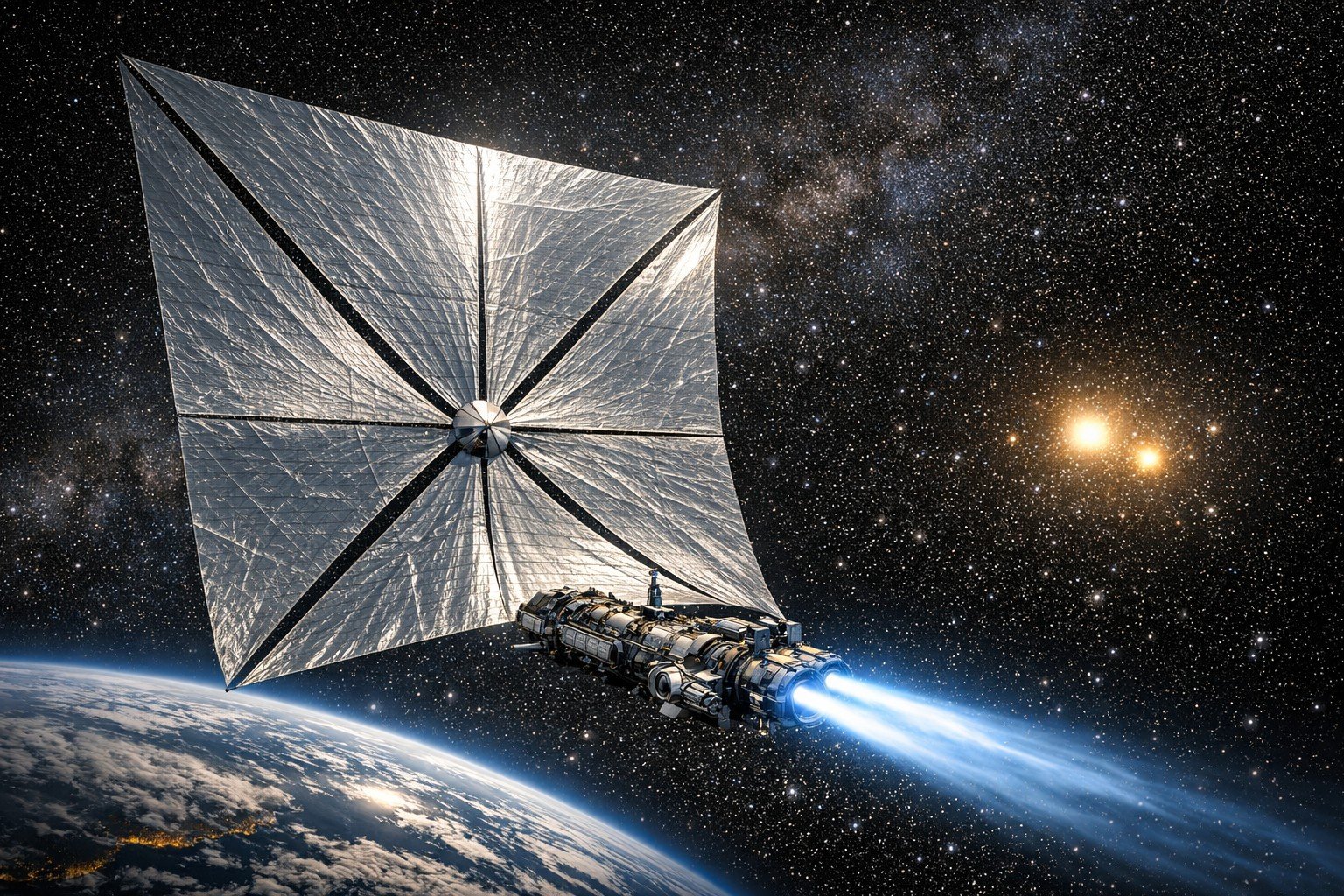
The Alpha Centauri Laser Propulsion Study sits a little over four light-years from Earth. That sounds close, at least by galactic standards, but “close” is doing a lot of heavy lifting in that sentence. A spacecraft using today’s chemical rockets would need hundreds of thousands of years to get there. That’s longer than modern humans have existed as a species.
So when a research team announced results from a new laser propulsion experiment aimed at cutting that timeline down to roughly 20 years, it understandably made headlines. The catch is that most of the coverage skipped past what the study actually demonstrated and jumped straight to the “20 years to Alpha Centauri” headline. That gap between the real science and the space-travel hype is worth closing.
This article walks through what the researchers actually built, why it matters, what it doesn’t prove yet, and how it fits into the decades-long effort to reach another star system without waiting a hundred human lifetimes.
What Is the Alpha Centauri Laser Propulsion Study?
The Alpha Centauri Laser Propulsion Study comes from a team at Texas A&M University, led by Dr. Shoufeng Lan, director of the school’s Lab for Advanced Nanophotonics. Their paper, published in the journal Newton, describes a new way to move tiny objects using nothing but laser light.
The devices at the center of the experiment are called “metajets.” They’re micron-scale structures — smaller than the width of a human hair — built from metasurfaces. A metasurface is a material engineered with microscopic patterns that control how light bounces off it, similar to how a lens bends light, except the patterning happens at a scale fine enough to shape the direction light gets reflected.
Here’s the part that makes this different from earlier light-propulsion work: when a laser hits one of these metajets, the researchers could steer it in three dimensions — up, down, sideways, and diagonally — using the angle and pattern of the light alone. No thrusters, no fuel, no physical contact. Previous light-propulsion demonstrations could typically push an object in one direction. This one can steer.
Lan compared the effect to a ping pong ball bouncing off a paddle. Light doesn’t have mass, but it does carry momentum, and when it reflects off a surface, some of that momentum transfers to the object. Each “bounce” gives a tiny push. On its own, that push is minuscule. But in the near-vacuum of space, with nothing to slow an object down, a small continuous force can add up to serious speed over time.
Why It Matters
The reason light propulsion keeps coming up in conversations about interstellar travel is simple: rockets run out of fuel, and fuel has mass, and mass is the enemy of speed. Every bit of propellant a spacecraft carries adds weight it then has to spend more propellant accelerating. It’s a loop that caps out well short of what’s needed to cross light-years in a human lifetime.
Light-based propulsion sidesteps that problem. A laser stays on Earth (or in orbit) and keeps pushing the spacecraft from a distance, so the ship itself doesn’t need to haul propellant. This is the same basic idea behind Breakthrough Starshot, the privately funded initiative that has spent years exploring gram-scale probes riding light sails at a meaningful fraction of the speed of light.
What the Texas A&M metajet study adds to that conversation is precision. Earlier light-sail concepts focused mostly on straight-line acceleration — get pushed, go fast, hope you’re pointed the right way. Full 3D steering means a future spacecraft could, in theory, adjust its own trajectory mid-flight using light alone. That’s a meaningfully different engineering problem, and solving it opens the door to course corrections, formation flying with multiple probes, and more controlled deceleration near a destination.
Key Benefits of Laser-Based Propulsion
No propellant required. The spacecraft doesn’t carry fuel, which means it can be dramatically lighter than anything built around chemical rockets.
Continuous acceleration. A rocket burns fuel for minutes. A laser can, in principle, keep pushing a craft for as long as the beam stays aimed and powered, building speed gradually over a much longer stretch of the journey.
Directional control. The 3D steering shown in this study suggests future systems won’t just go fast in one direction — they could adjust course, which matters enormously over a multi-year flight.
Scalability. Because the technology is built on metasurface patterning rather than exotic materials, the same manufacturing approach used for computer chips and optical devices could, in theory, scale up production.
Lower cost per mission (long-term). A ground-based or orbital laser array is a one-time infrastructure investment that could, in theory, launch many small probes rather than requiring a new heavy rocket for every mission.
Where the Research Stands Right Now
It’s worth being direct about the current stage of this work, because the gap between “demonstrated in a lab” and “sends a spacecraft to another star” is enormous.
What’s been shown: Researchers successfully lifted and steered micron-scale metajets using laser light in a controlled lab setting, achieving movement in three dimensions for the first time with this method.
What hasn’t been shown yet: The team hasn’t tested this in microgravity. Everything so far has happened under Earth’s gravity and atmosphere, both of which behave very differently than the vacuum of space. The researchers have said they’re pursuing funding to move testing into microgravity environments next.
The scale gap: A metajet is smaller than a grain of sand. A spacecraft — even a minimalist one built for interstellar travel — is a different engineering challenge entirely. Scaling from “steer a microscopic object a few millimeters” to “steer a functioning probe across trillions of miles” involves solving problems in materials science, beam stability, tracking, and power that this study doesn’t address.
Other groups working on related ideas: This isn’t happening in isolation. Breakthrough Starshot has spent years on light-sail concepts for interstellar probes. The European Space Agency has explored using lasers with lightweight materials like graphene aerogels to adjust satellite positioning. Caltech and the Rochester Institute of Technology are also pursuing related optical propulsion research. The metajet study is one piece of a broader, active field rather than a standalone breakthrough that solves interstellar travel on its own.
Common Misconceptions
“We’re 20 years away from sending a probe to The Alpha Centauri Laser Propulsion Study.” Not quite. The 20-year figure refers to a theoretical travel time if a laser-propelled spacecraft could reach the necessary speeds — it’s describing a possible future flight duration, not a current mission timeline. No spacecraft is being built or scheduled based on this study.
“Lasers are pushing full-size objects in this experiment.” The devices tested are microscopic. Nothing resembling a spacecraft has been moved this way yet.
“This is the same as Breakthrough Starshot.” It’s related but distinct. Starshot focuses on light sails — flat, reflective materials pushed by a laser array. The metajet research focuses on engineered surfaces that allow for directional steering, which is a different and complementary piece of the puzzle.
“Light propulsion means no engineering challenges left.” Power requirements alone are staggering. Pushing a craft to a meaningful fraction of light speed would require laser arrays far more powerful than anything currently built, plus a way to keep the beam precisely aimed at a target moving away at extreme speed.
Expert Tips for Understanding Coverage of Studies Like This
If you want to follow this kind of research without getting misled by headlines, a few habits help.
Check whether the story describes a lab demonstration or an actual mission. Words like “could,” “may,” and “one day” are doing real work in most headlines about interstellar travel.
Look for the actual published paper, not just the press release. In this case, the paper appeared in Newton, a peer-reviewed journal, which is a meaningful signal that the results went through scientific review.
Notice the scale. A study involving objects smaller than a grain of sand is a fundamentally different claim than a study involving a spacecraft-sized object.
Pay attention to what researchers say they’re doing next. When a team says they’re seeking funding for microgravity testing, that tells you they’re still early in validating the concept outside lab conditions — which is honest and normal, but worth knowing.
Frequently Asked Questions
What is the alpha centauri laser propulsion study about? It’s research from Texas A&M University demonstrating that laser light can lift and steer microscopic engineered devices called metajets in three dimensions, without any physical contact or onboard fuel.
Could this technology actually get a spacecraft to Alpha Centauri in 20 years? That figure is a theoretical estimate of how fast a laser-propelled craft could travel if the underlying physics scales up successfully. It’s not a mission timeline, and no spacecraft has been built or launched using this method.
How is this different from a solar sail? A solar sail is pushed passively by sunlight or a laser beam and generally moves in one general direction. The metajet approach uses engineered surface patterns to control the direction of movement more precisely, allowing for steering rather than just a push.
Is this the same project as Breakthrough Starshot? No. Breakthrough Starshot is a separate, privately funded initiative focused on light-sail probes. The Texas A&M metajet research is a different project exploring directional control through engineered metasurfaces, though both fall under the broader field of laser-based propulsion.
What’s the biggest obstacle before this could be used in real space missions? Scale and power. The experiment involves objects far smaller than any real spacecraft, and it has only been tested in normal gravity so far. Building and powering a laser system capable of moving something spacecraft-sized, while tracking it accurately over vast distances, remains an unsolved engineering problem.
When will microgravity testing happen? As of the study’s publication, the research team said they were seeking external funding to move testing into microgravity conditions. No confirmed timeline has been announced publicly.
Why does laser propulsion matter if rockets already work? Rockets are limited by how much fuel they can carry, and fuel adds weight that slows acceleration. Laser propulsion keeps the power source on Earth or in orbit, so the spacecraft itself can be lighter and, in theory, reach much higher speeds over time.
Are other research groups working on similar interstellar propulsion methods? Yes. Organizations including the European Space Agency, Caltech, and the Rochester Institute of Technology are pursuing related work in optical and light-based propulsion, alongside the privately funded Breakthrough Starshot initiative.
Final Thoughts
This study doesn’t send anyone to The Alpha Centauri Laser Propulsion Study. What it does is solve a real, specific engineering problem — steering an object with light alone, in three dimensions, without touching it — that previous experiments hadn’t managed. That’s a genuine step forward, even if the distance between “steering a microscopic device in a lab” and “flying a probe past our nearest star” is still measured in decades of additional research.
If you’re following this field, the honest takeaway is patience paired with attention. Interstellar travel research moves in increments like this one: a new degree of control, a new material, a new way to squeeze more precision out of a beam of light. None of it guarantees a mission timeline. All of it, taken together, is how a genuinely far-off idea slowly becomes less far-off.