

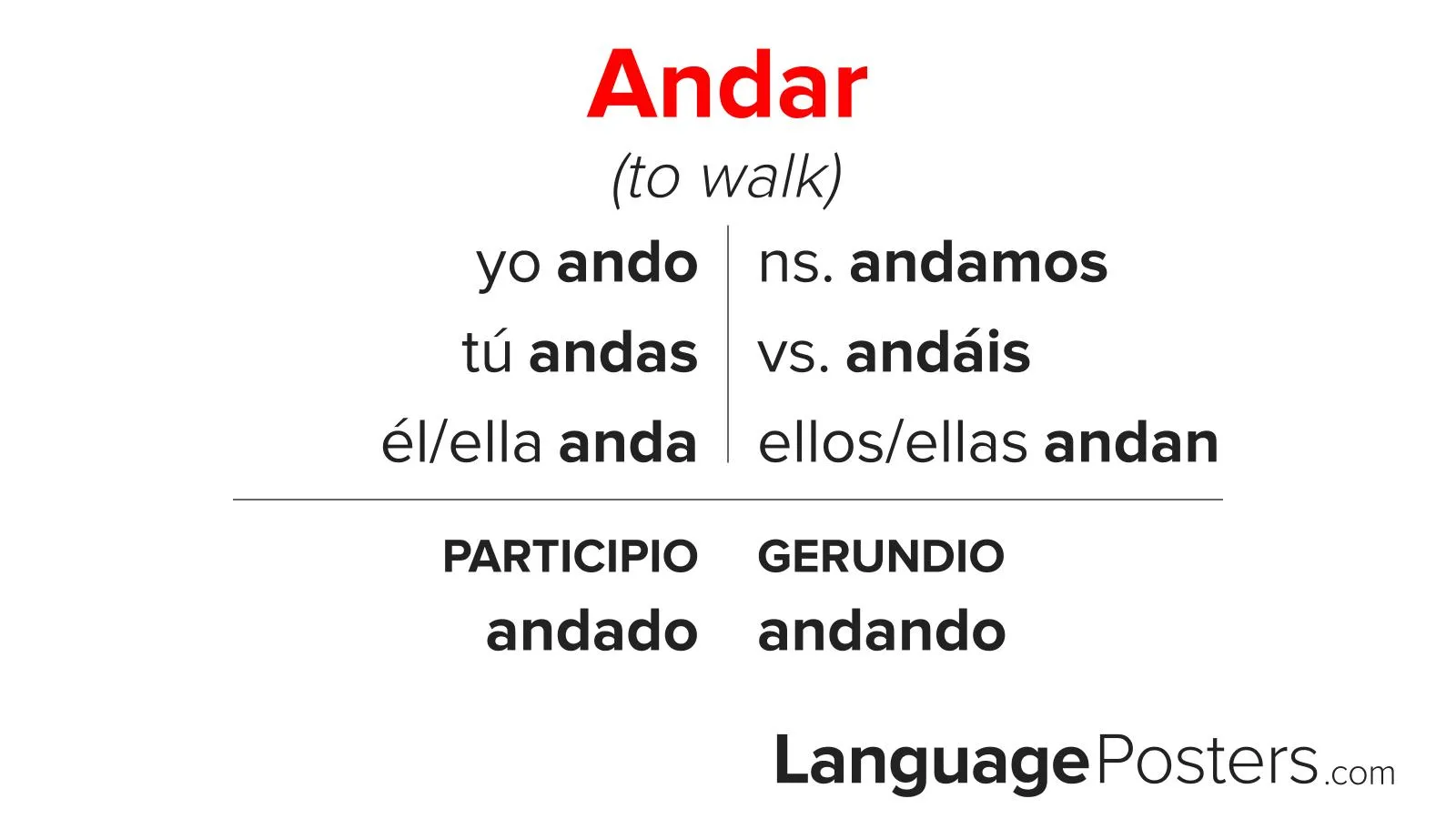
Anyone who has studied Spanish for more than a few months eventually runs into a wall of irregular preterite verbs that refuse to follow the rules everyone just learned. Andar is one of them. It looks like a simple -ar verb on the surface, but the moment you try to put it in the past tense, it throws out the regular endings and borrows a pattern from a completely different family of verbs.
This guide breaks down the Andar Preterite conjugation, explains why it behaves the way it does, and shows you how to actually use it in real sentences — not just memorize a chart and forget it by next week.
What Is Andar in Spanish?
Andar Preterite means “to walk” or “to go around,” though its meaning stretches further than that in everyday speech. Spanish speakers use it for walking, wandering, being in a certain state (“andar mal de dinero” — to be short on money), or even functioning like “to be doing” something (“¿qué andas haciendo?” — what are you up to?).
Because it’s such a common, flexible verb, you’ll bump into it constantly once you start reading or listening to native Spanish. And sooner or later, you’ll need to talk about something that already happened — which means dealing with the preterite.
Why the Andar Preterite Trips People Up
Here’s the part that catches most learners off guard: andar is a regular -ar verb in the present tense, but it becomes irregular in the preterite. Instead of following the predictable -é, -aste, -ó pattern that verbs like “hablar” or “caminar” use, andar switches to a stem that ends in a “u” sound and pairs it with endings borrowed from -er/-ir irregular verbs.
This isn’t a random quirk. Andar Preterite belongs to a small group of Spanish verbs — including estar, tener, and poder — that share this same irregular pattern in the preterite. Once you learn one of them well, the others become much easier to remember, because they all follow the same logic.
The Full Andar Preterite Conjugation
| Subject | Conjugation |
|---|---|
| yo | anduve |
| tú | anduviste |
| él / ella / usted | anduvo |
| nosotros/as | anduvimos |
| vosotros/as | anduvisteis |
| ellos/ellas/ustedes | anduvieron |
Notice a few things right away:
- The stem changes from and- to anduv- across every form.
- None of the forms carry a written accent mark, which is different from regular preterite verbs (compare “habló” with an accent versus “anduvo” without one).
- The endings themselves — -e, -iste, -o, -imos, -isteis, -ieron — are the same ones used by other irregular preterite verbs like tener (tuve) and estar (estuve).
That last point is the key to remembering this conjugation long term. If you already know the preterite of estar, you basically already know andar. Just swap “estuv-” for “anduv-” and the rest falls into place.
When to Use Andar in the Preterite
You’ll reach for the andar preterite any time you’re describing a completed action of walking, moving around, or being in a particular state at some point in the past. A few natural examples:
- Anduve por el centro toda la tarde. (I walked around downtown all afternoon.)
- Anduvimos perdidos durante una hora. (We were lost — wandering around lost — for an hour.)
- ¿Por dónde anduviste ayer? (Where were you wandering around yesterday?)
- Andrea anduvo diciendo cosas raras en la fiesta. (Andrea was going around saying strange things at the party.)
That third and fourth example show something worth pointing out: Andar Preterite in the preterite often pairs with another verb form (usually a gerund, like “diciendo” or “buscando”) to describe someone going around doing something, almost like an ongoing background activity that got wrapped up as a finished event. This use doesn’t translate cleanly into English, which is part of why it confuses learners — there isn’t a single English structure that captures it every time.
Andar vs. Ir in the Preterite: A Common Point of Confusion
Learners often mix up andar and ir because both can loosely relate to movement, and their preterite forms sound nothing alike, which somehow makes it worse rather than better.
Ir means “to go” and points toward a destination: Fui al mercado. (I went to the market.) The focus is on the trip and the endpoint.
Andar means “to walk around” or “to move about” without a fixed destination in mind: Anduve por el mercado. (I walked around the market.) The focus is on the movement itself, not where it ended up.
If your sentence has a clear destination — a place you went to — ir usually fits better. If you’re describing wandering, roaming, or being in motion without a specific endpoint, andar is the natural choice.
Common Mistakes with the Andar Preterite
Adding an accent mark where it doesn’t belong. Because so many regular preterite verbs carry accents on the yo and él/ella forms (hablé, habló), learners sometimes write “andúve” or “andúvo.” Don’t. The irregular preterite forms of andar never take a written accent.
Confusing andar with andar + gerund constructions. “Anduve caminando” sounds redundant to English ears (literally “I walked walking”), so some learners avoid the andar + gerund pattern altogether. It’s actually a normal, useful structure in Spanish for emphasizing an ongoing action — just not one you need to force into every sentence.
Mixing up andar and andar’s regular-looking cousins. Some learners assume that because andar ends in -ar, it must follow the same preterite pattern as verbs like “hablar” or “trabajar.” It doesn’t. Treat it as its own irregular verb from day one, and you’ll save yourself a lot of correction later.
Forgetting that the stem changes across all six forms. Some irregular verbs only shift in a few conjugations. Andar shifts in all of them — there’s no “yo anduve, but tú andaste” shortcut. The and- to anduv- change is consistent throughout.
Tips for Remembering the Andar Preterite
- Anchor it to estar. If you already have “estuve, estuviste, estuvo, estuvimos, estuvisteis, estuvieron” memorized, just swap the “est-” for “and-.” The endings are identical.
- Say it out loud in short phrases, not isolated conjugations. “Anduve solo,” “anduvimos juntos,” “anduvieron tarde” — practicing with context sticks better than reciting a bare verb chart.
- Notice it in real Spanish. Once you know what to listen for, you’ll start catching “anduve” and “anduvimos” in songs, shows, and conversations far more often than you’d expect from a verb that seems obscure in a textbook.
- Write a few sentences about your own day. Where did you wander around today? What were you up to (¿qué anduviste haciendo)? Personal, low-stakes practice tends to outperform drilling a conjugation table from a workbook.
Frequently Asked Questions
Is andar a regular or irregular verb in the preterite? Irregular. While andar behaves like a normal -ar verb in the present tense, its preterite stem changes to “anduv-” and takes endings borrowed from irregular verbs like estar and tener.
What is the yo form of andar in the preterite? Anduve, with no written accent. This is different from regular -ar preterite verbs, where the yo form typically ends in an accented -é.
Does andar in the preterite ever take accent marks? No. None of the six preterite forms of andar (anduve, anduviste, anduvo, anduvimos, anduvisteis, anduvieron) carry a written accent.
What’s the difference between anduve and estuve? They follow the same irregular pattern and endings, but come from different verbs. Anduve comes from andar (to walk/move around) and estuve comes from estar (to be, often describing a state or location). They aren’t interchangeable, even though they sound similar.
Can andar be used to mean something other than “to walk” in the preterite? Yes. It can describe being in a certain condition (“anduve enfermo” — I was sick, or literally “I went around sick”), or being occupied with something (“anduvo trabajando” — he was off working). Context determines the exact shade of meaning.
Is anduve the same as caminé? Not exactly. Caminé (from caminar) usually refers specifically to the physical act of walking. Anduve is broader — it can mean walking, but it can also describe general movement, wandering, or a state of being, depending on the sentence.
How do I know when to use the andar preterite instead of the imperfect form (andaba)? Use the preterite (anduve) for a completed action or a walk/wander that had a clear beginning and end. Use the imperfect (andaba) for a background action, a habitual action, or a description of what was happening at some point in the past without focusing on when it ended.
Final Thoughts
The andar preterite isn’t difficult once you see the pattern behind it — it just doesn’t announce itself the way regular verb conjugations do. Learn it alongside estar and tener, practice it in real sentences rather than isolated verb charts, and pay attention to how native speakers use it to describe wandering, states of being, and ongoing background actions. Once “anduve, anduviste, anduvo, anduvimos, anduvisteis, anduvieron” feels automatic, you’ll have one less irregular verb standing between you and comfortable, natural Spanish.