
Few horror ideas have proved as flexible as the zombie. A dead person coming back to life sounds simple, but filmmakers have used that idea to tell stories about fear, survival, disease, family, society, politics, and human nature.
The best zombie movies are not all about blood and jump scares. Some are fast and terrifying. Others are darkly funny, surprisingly emotional, or built around social commentary. There are also major differences between traditional slow-moving undead films and modern stories featuring infected humans who can move with frightening speed.
That variety makes choosing a zombie film harder than it sounds. If you are looking for something genuinely scary, a classic worth seeing, a fun comedy, or an intense survival story, the right choice depends heavily on your taste.
This guide breaks down the major types of zombie films and highlights movies that are worth considering.
What Are Zombie Movies?
Zombie movies generally revolve around dead people who return to life or people transformed into zombie-like creatures. Their behavior and origin vary considerably from one film to another.
Early zombie cinema often connected the undead with supernatural forces, voodoo traditions, or mysterious reanimation. Later filmmakers increasingly used zombies as a metaphor for social problems, consumer culture, disease, fear, and societal collapse.
The word “zombie” can therefore describe several different types of creatures.
Some are slow, relentless corpses that overwhelm victims through sheer numbers. Others are living humans infected by a virus or mysterious disease. Some can run, climb, think, or even retain fragments of their former personalities.
That distinction matters when choosing what to watch. Someone who enjoys atmospheric horror may prefer a slow-burn undead film, while another viewer might want the relentless pace of an outbreak thriller.
Why Zombie Movies Remain Popular
The zombie genre has a useful advantage: it can adapt to almost any style of storytelling.
A filmmaker can make a zombie movie primarily as horror, comedy, action, science fiction, drama, or even satire. The undead become the central threat, while the real story often concerns the people trying to survive.
There is also something especially effective about zombie stories as survival narratives. Characters usually have limited resources, uncertain information, and difficult choices. A safe location can become dangerous within minutes.
The strongest films understand that tension comes from more than simply showing monsters. They make viewers care about what happens to the people involved.
The Main Types of Zombie Movies
Classic Slow Zombies
Traditional zombies are usually slow-moving and physically limited. They are dangerous because they keep coming and rarely get tired.
This style creates a different kind of suspense from fast zombies. A single slow zombie might not seem particularly frightening. A hundred of them surrounding a building is another matter.
Classic zombie films often emphasize atmosphere, isolation, and the breakdown of social order.
Fast Zombies and Infected Humans
Modern zombie cinema popularized much faster creatures.
These characters are sometimes technically infected humans rather than resurrected corpses. They can sprint, attack aggressively, and turn an ordinary situation into chaos almost instantly.
Films such as 28 Days Later helped make this approach influential in modern horror.
Fast zombies change the survival equation. Running away may be necessary because hiding is no longer enough.
Zombie Comedies
Zombie stories do not always take themselves seriously.
Comedy can work remarkably well with the genre because zombies provide exaggerated situations: barricading houses, arguing over survival plans, searching for weapons, and discovering that everyday habits suddenly make little sense.
Shaun of the Dead is one of the best-known examples of the horror-comedy approach.
Zombie Action Movies
Some films treat the undead outbreak as an action problem.
Expect weapons, large-scale attacks, military responses, desperate escapes, and increasingly dangerous encounters. These movies generally prioritize momentum over slow atmospheric horror.
They are ideal when you want a zombie film that feels closer to an action thriller.
Emotional and Character-Driven Zombie Films
Other films use the zombie setting to explore relationships.
The outbreak becomes a backdrop for questions about family, grief, loyalty, sacrifice, and identity. These movies can be especially effective because the emotional stakes remain meaningful even when the horror elements are removed.
Best Zombie Movies to Start With
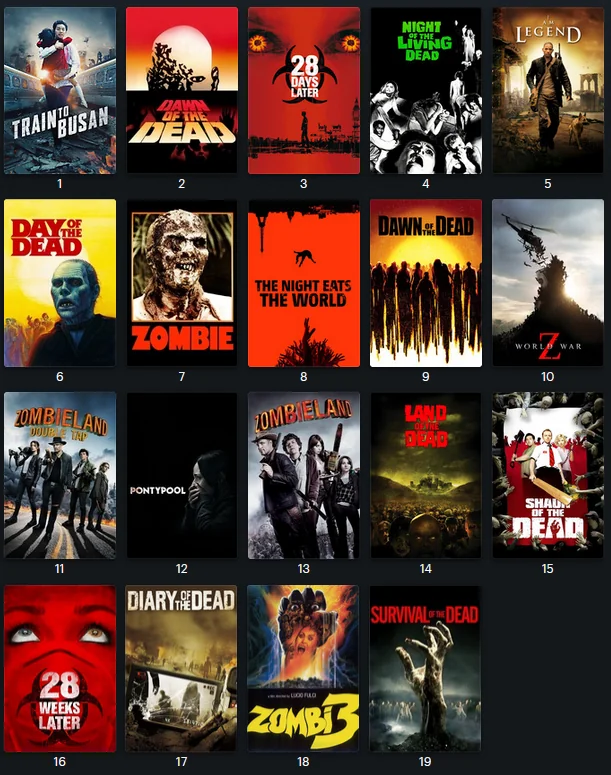
There is no single objective ranking because different films serve very different purposes. Instead, think of these as useful starting points for different tastes.
Night of the Living Dead (1968)
George A. Romero’s landmark film helped establish many conventions associated with modern zombie cinema.
Its power does not come from elaborate effects. The movie creates tension through confinement, uncertainty, and conflict among the survivors.
It is particularly valuable for viewers interested in the history of the genre.
Dawn of the Dead (1978)
Romero expanded the concept into a larger and more ambitious story.
The shopping-mall setting gives the movie room to explore consumer culture while still delivering plenty of undead horror. It remains an important film for understanding how zombies became more than simple monsters.
Day of the Dead (1985)
This installment takes a darker, more claustrophobic approach.
The story focuses heavily on scientists, soldiers, and the growing conflict between groups attempting to survive the apocalypse. It is a strong choice for viewers who enjoy tension between human characters as much as the monsters themselves.
28 Days Later (2002)
Danny Boyle’s film helped popularize a more frantic style of outbreak horror.
The movie combines deserted environments, psychological tension, and extremely aggressive infected humans. Its opening sequences are particularly effective at creating a feeling of isolation.
Shaun of the Dead (2004)
For viewers who want horror mixed with comedy, this is an obvious recommendation.
It understands zombie conventions well enough to parody them without making the story feel pointless. Beneath the jokes is also a surprisingly human story about friendship and growing up.
Dawn of the Dead (2004)
Zack Snyder’s remake takes the basic concept in a much faster direction.
The result is more action-oriented than Romero’s original. If you prefer intense pacing and aggressive undead creatures, this version may be a better starting point.
[REC] (2007)
This Spanish horror film uses a found-footage approach to create an unusually confined experience.
The limited viewpoint is important. You often know only what the characters know, which makes the outbreak feel immediate and unpredictable.
Train to Busan (2016)
This South Korean thriller combines zombie horror with an emotionally focused survival story.
The train setting creates natural physical limitations. Characters cannot simply disappear into an enormous landscape; they must move through narrow compartments while the threat spreads.
That setup makes the film accessible even to viewers who do not normally watch zombie movies.
How to Choose the Right Zombie Movie
Start with the kind of experience you want rather than searching for a generic “best” movie.
For classic horror: Try Night of the Living Dead or Dawn of the Dead.
For fast-paced horror: 28 Days Later or the 2004 Dawn of the Dead are strong options.
For comedy: Shaun of the Dead is an excellent starting point.
For emotional storytelling: Train to Busan offers both horror and strong character relationships.
For found-footage tension: [REC] is worth considering.
For genre history: Begin with Romero’s original films.
This approach is more useful than relying on rankings alone. A technically excellent film may still be the wrong choice if its style does not match what you enjoy.
Common Mistakes When Choosing Zombie Movies
Assuming Every Zombie Movie Is the Same
They are not.
The difference between a slow Romero-style zombie film and a fast infected-human thriller can be enormous. Check the movie’s style before starting it.
Ignoring the Movie’s Age
Older horror films often use atmosphere, practical effects, and suspense differently from modern productions.
If you normally watch recent blockbusters, a 1960s or 1970s film may feel slower. That does not necessarily mean it is less effective.
Choosing Only by Gore
Gore can be entertaining, but it is rarely enough to carry a full movie.
Look at the premise, characters, pacing, and overall tone as well. Some of the genre’s strongest films remain memorable because of what happens between the attacks.
Expecting Every Film to Follow the Same Rules
Zombie mythology changes from movie to movie.
Some zombies are reanimated corpses. Others are infected living people. The rules surrounding bites, transformation, intelligence, and physical abilities can also differ.
Pay attention to the film’s own rules rather than expecting every movie to follow the same fictional universe.
Expert Tips for Watching Zombie Movies
Watch the Classics Before the References
Modern zombie entertainment frequently borrows ideas established by earlier filmmakers.
Watching a few influential classics can make later movies more interesting because you start recognizing the conventions being used, changed, or deliberately mocked.
Pay Attention to the Survivors
The monsters are usually predictable: they want to attack people.
The survivors are where the story becomes interesting.
Watch how characters respond when food, shelter, trust, and information become scarce. Their decisions often create as much tension as the zombies themselves.
Consider Watching in Release Order
If you want to understand the evolution of the genre, release order is useful.
You can see the movement from supernatural zombie stories toward Romero’s modern undead, outbreak-style infected creatures, comedy, action-heavy productions, and international interpretations.
Choose the Right Setting
The setting can completely change the experience.
A shopping mall, apartment building, train, hospital, rural farm, or deserted city gives filmmakers different ways to create danger. Confined locations often produce intense suspense, while open environments can emphasize loneliness and scale.
Frequently Asked Questions About Zombie Movies
What are the best zombie movies?
There is no universal answer, but Night of the Living Dead, Dawn of the Dead, 28 Days Later, Shaun of the Dead, [REC], and Train to Busan are strong starting points for different styles.
What are zombie movies usually about?
They often involve survival during an outbreak or undead uprising, but many also explore themes such as fear, social breakdown, consumerism, family, isolation, and human behavior under pressure.
What is the difference between zombies and infected people?
Traditional zombies are generally reanimated dead bodies. Infected characters are usually living people affected by a disease or biological agent. Different films use these terms and concepts differently.
Are old zombie movies worth watching?
Absolutely, especially if you want to understand the genre. Older productions may have slower pacing and different effects, but many rely on atmosphere, practical filmmaking, and strong ideas rather than spectacle.
Which zombie movies are good for beginners?
Train to Busan is a strong modern starting point, while Shaun of the Dead works well if you want comedy. For classic horror, Night of the Living Dead is an essential choice.
Are all zombie movies scary?
No. The genre includes horror, comedy, action, drama, science fiction, and satire. Some films are genuinely frightening, while others are designed primarily to entertain.
Why do zombie movies use outbreaks so often?
An outbreak creates an immediate survival problem and allows the story to explore how individuals and institutions respond when normal systems stop working. It also provides a believable framework for the rapid spread of danger.
Final Thoughts
The appeal of zombie movies comes from their flexibility. The undead can be frightening monsters, symbols of social problems, targets for comedy, or a backdrop for deeply emotional stories.
If you are new to the genre, do not worry about finding one definitive “best” film. Start by deciding what you want: classic horror, fast-paced action, comedy, found-footage suspense, or an emotional survival story.
Once you understand those differences, exploring the genre becomes much easier. And if one style does not work for you, another probably will.