

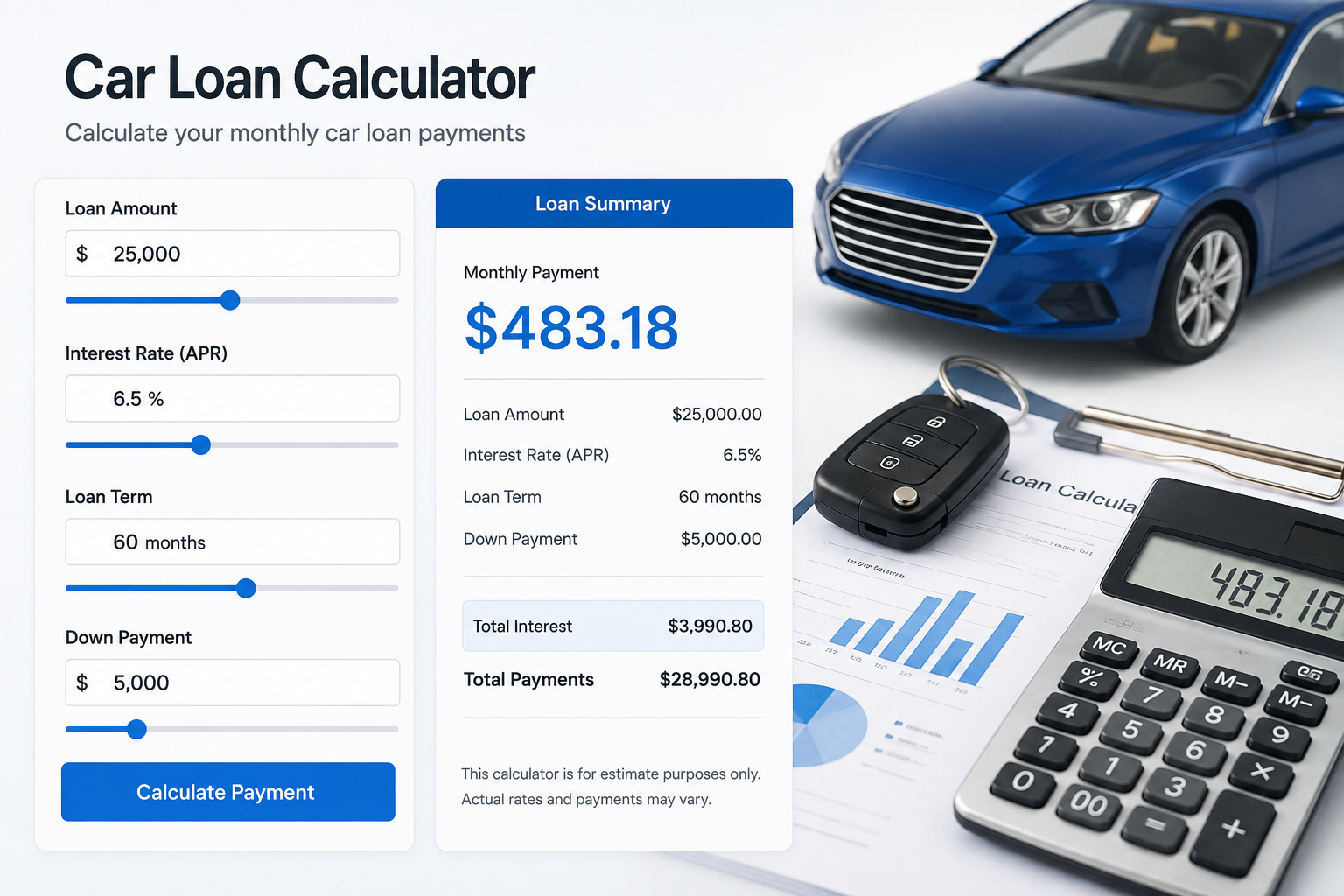
Buying a car is easier when you know what the financing will actually cost. The sticker price is only one part of the equation. Your down payment, interest rate, loan term, taxes, fees, and trade-in value can all change the amount you pay each month.
A car loan calculator gives you a quick way to bring those numbers together. Instead of guessing whether a vehicle fits your budget, you can estimate the monthly payment and see how different loan choices affect the total amount you’ll repay.
The useful part isn’t simply finding one monthly number. A good calculation helps you compare scenarios. For example, you might discover that adding a larger down payment lowers your monthly bill, while extending the loan term makes the payment smaller but increases the amount of interest you pay over time.
Here’s how to use the numbers intelligently before signing an auto loan.
What Is a Car Loan Calculator?
A car loan calculator is a financial tool that estimates the payment on an auto loan using several basic inputs.
Typically, you enter:
- Vehicle price
- Down payment
- Trade-in value
- Sales tax and fees
- Loan amount
- Annual percentage rate (APR)
- Loan term
- Payment frequency, depending on the calculator
The calculator then estimates your periodic payment and, in many cases, shows the total interest and total amount paid over the life of the loan.
The basic loan-payment calculation is based on the amount borrowed, interest rate, and number of payments. Real-world auto financing can be more complicated because taxes, fees, add-ons, and lender-specific terms may affect the final amount financed.
That is why the calculator should be treated as a planning tool rather than a guaranteed loan offer.
Why Your Monthly Payment Isn’t the Whole Story
A $450 monthly payment can sound affordable. But that number doesn’t tell you how long you’ll be making payments or how much the vehicle will ultimately cost.
Consider a simplified example:
Suppose you finance $25,000 at 7% APR.
With a 48-month loan, the estimated principal-and-interest payment is about $599 per month.
With a 72-month loan, it falls to roughly $426 per month.
The longer loan appears easier on your monthly budget, but you’ll make payments for an additional two years and generally pay more interest.
This is one of the biggest reasons shoppers should compare the total cost of financing, not just the monthly payment.
How a Car Loan Calculator Works
Most standard auto loans use an amortizing payment structure. Each payment contains both principal and interest.
Early in the loan, a larger portion of the payment typically goes toward interest. As the outstanding balance decreases, more of each payment goes toward reducing the principal.
The standard formula is:
M = P × [r(1+r)ⁿ] ÷ [(1+r)ⁿ − 1]
Where:
- M = monthly payment
- P = amount financed
- r = monthly interest rate
- n = total number of monthly payments
For example, an annual interest rate of 6% would generally be converted to a monthly rate of 0.5% for this calculation.
This formula estimates principal and interest. Taxes, registration, dealer fees, optional products, and other charges may need to be included separately.
What Numbers Should You Enter?
Getting useful results depends on entering realistic numbers.
Vehicle Price
Start with the actual purchase price you’re considering rather than relying only on the vehicle’s advertised price.
A car advertised at $30,000 could have additional taxes, documentation fees, registration costs, or optional products that affect the final amount financed.
Down Payment
Your down payment reduces the amount you need to borrow.
For example:
- Vehicle price: $30,000
- Down payment: $6,000
- Amount before other adjustments: $24,000
A larger down payment can reduce both the monthly payment and the interest charged over the loan.
However, putting more money down isn’t automatically the best choice for everyone. You should still keep enough cash available for emergencies and other important expenses.
Trade-In Value
If you’re trading in an existing vehicle, its value can reduce the amount you need to finance.
Suppose you buy a $30,000 car and receive $8,000 for your trade-in. The calculation may start from a substantially lower amount, depending on taxes, any remaining loan balance, and how the transaction is structured.
If you still owe money on the trade-in, don’t simply enter its full market value. You need to account for the outstanding loan balance.
Interest Rate
The APR has a major impact on your financing cost.
Your actual rate can depend on factors such as credit history, loan term, lender, vehicle type, income, and other underwriting criteria.
When comparing lenders, look at APR rather than focusing only on the monthly payment.
Loan Term
Common auto-loan terms include 36, 48, 60, 72, and sometimes longer periods.
A longer term usually produces a lower monthly payment, but it can increase total interest and keep you in debt longer.
Taxes and Fees
Don’t forget costs that may be rolled into the loan.
Depending on where you live and how the purchase is structured, these may include sales tax, registration charges, documentation fees, and other transaction costs.
If the calculator allows separate fields for these expenses, use them.
Step-by-Step: How to Use a Car Loan Calculator
Using one effectively is straightforward.
Step 1: Determine the Vehicle’s Real Price
Start with the negotiated purchase price or the best realistic estimate.
Don’t base your budget exclusively on the manufacturer’s suggested retail price or a promotional advertisement.
Step 2: Add Your Down Payment
Enter the amount you’re comfortable paying upfront.
Avoid choosing a down payment that leaves you without enough savings for unexpected expenses.
Step 3: Include Your Trade-In
If you’re trading a vehicle, estimate its realistic value and account for any remaining loan balance.
Step 4: Enter the APR
Use the rate you actually expect to qualify for when possible.
If you don’t have an approved offer yet, test several rates. This gives you a better idea of how sensitive your payment is to financing costs.
Step 5: Compare Loan Terms
Run the numbers for several terms.
For example, compare:
- 36 months
- 48 months
- 60 months
- 72 months
Don’t automatically choose the lowest monthly payment.
Step 6: Review Total Interest
This is where the calculator becomes particularly useful.
Two loans can have similar monthly payments but very different total financing costs.
Look at:
Total payments − amount financed = approximate interest paid
For a simple fixed-rate loan without additional financed charges, this provides a useful estimate of the interest cost.
How Interest Rate Changes Your Payment
Even a relatively small change in APR can make a noticeable difference over several years.
Imagine borrowing $25,000 for 60 months.
At a lower interest rate, more of your payment goes toward principal. At a higher rate, more money goes toward interest.
That’s why it’s worth shopping around before accepting the first financing offer.
A bank, credit union, online lender, or dealership may offer different terms. The best option isn’t necessarily the lender with the lowest advertised rate; you need to consider the complete loan offer.
Should You Choose a Longer Loan Term?
A longer term can make sense in some circumstances, particularly when it helps keep a necessary vehicle within a manageable monthly budget.
But there are trade-offs.
Advantages
- Lower monthly payment
- More flexibility in monthly cash flow
- May allow you to purchase a vehicle without exceeding a monthly budget
Disadvantages
- More interest over time
- Longer period of debt
- Greater risk of owing more than the vehicle is worth
- More time before the loan is completely paid off
The important question isn’t simply, “Can I afford this monthly payment?”
Ask instead:
“How much will this vehicle cost me by the time the loan is finished?”
Common Car Loan Calculator Mistakes
Looking Only at the Monthly Payment
This is probably the easiest mistake to make.
A dealer can sometimes make a payment appear more affordable by extending the loan term. Always compare the term and total financing cost alongside the payment.
Forgetting Taxes and Fees
A calculator result based only on the vehicle price may underestimate what you’ll actually finance.
Include realistic taxes and fees when the tool allows it.
Using an Unrealistically Low Interest Rate
Don’t build your budget around a promotional APR unless you have a reasonable chance of qualifying for it.
Run multiple scenarios instead.
Ignoring Your Existing Car Loan
If your trade-in has negative equity, that balance can affect the new financing amount.
For example, if your vehicle is worth $15,000 but you owe $18,000, you have approximately $3,000 of negative equity before considering other transaction details.
That amount may need to be paid separately or incorporated into the new financing, depending on the deal.
Borrowing the Maximum You Can Qualify For
A lender approving a loan doesn’t necessarily mean the vehicle is comfortable for your household budget.
Your personal budget should determine the payment you’re willing to accept—not simply the maximum amount a lender offers.
How to Lower the Cost of Your Auto Loan
There are several practical ways to reduce financing costs.
Improve Your Credit Before Applying
If you’re planning a vehicle purchase, improving your credit profile before applying may help you qualify for better financing terms.
Paying bills on time, reducing outstanding balances, and reviewing your credit reports for errors can be useful steps.
Make a Reasonable Down Payment
A larger down payment means borrowing less.
But don’t drain your savings just to reduce the loan balance. Maintaining an emergency reserve is also important.
Compare Multiple Lenders
Don’t assume dealership financing is your only option.
Getting a quote from a bank or credit union can give you a useful benchmark when evaluating the dealer’s offer.
Keep the Loan as Short as You Can Comfortably Afford
If your budget supports a shorter term, you may pay less interest overall.
The key word is comfortably. A shorter loan isn’t helpful if it creates financial stress every month.
Avoid Unnecessary Add-Ons
Extended warranties, service contracts, insurance products, accessories, and other extras can increase the amount financed.
Some may be valuable depending on your circumstances, but understand their price before adding them to the loan.
Car Loan Calculator vs. Dealer Payment Quote
These two numbers can look similar but serve different purposes.
A calculator provides an estimate based on the assumptions you enter.
A lender’s or dealer’s quote is based on an actual financing offer and may include specific taxes, fees, APR, term, and other conditions.
Use the calculator before visiting the dealership to establish a realistic budget. Then compare the actual offer against your calculations.
If the numbers don’t match, ask why.
What About Leasing?
A car loan calculator is designed primarily for vehicle financing, not leasing.
A lease has a different structure. Instead of financing the full purchase price in the traditional sense, lease payments generally reflect factors such as depreciation, money factor, fees, mileage limits, and the vehicle’s expected residual value.
If you’re deciding between buying and leasing, compare the total cost under both arrangements rather than comparing only their monthly payments.
A Simple Example
Imagine you’re considering a vehicle priced at $32,000.
You have:
- $5,000 available for a down payment
- $2,000 estimated trade-in value
- A 60-month loan
- A hypothetical 7% APR
Before finalizing anything, you could run several scenarios:
Scenario A: $5,000 down
Scenario B: $7,000 down
Scenario C: 48-month loan
Scenario D: 60-month loan
Scenario E: Different APR after receiving another lender’s offer
This comparison tells you much more than a single payment estimate.
You can see exactly how changing the down payment, interest rate, or loan length affects the deal.
Expert Tips for Using a Car Loan Calculator
Run multiple scenarios. Don’t enter one set of numbers and stop. Test different down payments, terms, and interest rates.
Use the actual amount financed. If taxes and fees are being financed, include them.
Separate affordability from qualification. A lender may approve a loan that doesn’t fit comfortably into your budget.
Compare total interest. A lower monthly payment isn’t necessarily a cheaper loan.
Get financing quotes before negotiating the final deal. Knowing your financing options can make it easier to evaluate the dealership’s offer.
Check the contract carefully. The final paperwork—not the calculator—determines your actual obligation.
Frequently Asked Questions
What is a car loan calculator used for?
A car loan calculator estimates your payment based on the loan amount, APR, and repayment term. More advanced calculators can also account for down payments, trade-ins, taxes, and fees.
How accurate is a car loan calculator?
It can provide a useful estimate, but the result isn’t a guaranteed financing offer. Your actual payment may differ because of lender terms, taxes, fees, credit factors, and other charges.
Does a higher down payment reduce car loan interest?
Generally, yes. Borrowing less means there is less principal on which interest can accrue. However, you should balance a larger down payment against the need to maintain adequate savings.
Can I use a car loan calculator with bad credit?
Yes. You can use one with any expected APR. If you don’t know your likely rate, calculate several scenarios using different interest rates to see how your payment could change.
Should I choose a 60-month or 72-month auto loan?
It depends on your budget and priorities. A 72-month loan generally has a lower monthly payment but can result in more interest and a longer period of debt. Compare the total cost before choosing.
Does a trade-in reduce my car payment?
Usually, a trade-in can reduce the amount you need to finance. However, if you still owe more on the trade-in than it’s worth, negative equity can increase the amount that needs to be financed.
Can a car loan calculator tell me whether I can afford a car?
Not by itself. It tells you what the financing may cost. You should also consider insurance, fuel, maintenance, registration, parking, and other ownership expenses.
Is the lowest monthly car payment the best deal?
Not necessarily. A low payment may result from a longer loan term. Compare APR, loan length, total interest, and total amount paid—not just the monthly figure.
Final Thoughts
A car loan calculator is most useful when you treat it as a comparison tool rather than a simple payment generator. Before buying, test different loan terms, down payments, interest rates, and financing amounts.
The goal isn’t merely to find a payment you can technically make. It’s to understand the full cost of the vehicle and choose financing that fits your broader financial situation.
A few minutes of careful calculation can reveal whether a deal is genuinely affordable—or simply made to look affordable by stretching the loan over more years.